Mars Market: what it is, how it works
Mars Market is a drug-focused darknet market on Tor, open since January 2025. It takes Bitcoin and Monero, holds buyer payments in walletless escrow unless the vendor sells on direct pay, and lets every account lock its login behind a PGP challenge. Our read in November 2026: Mars is a real, working market, not a scam front, and it has outlasted the exits that killed DarkMatter and Nexus this autumn. It is also under two years old and mid-sized, and the biggest everyday risk around it is not Mars itself but the lookalike sites that borrow its name.
Mars was answering on its signed addresses when we checked on .
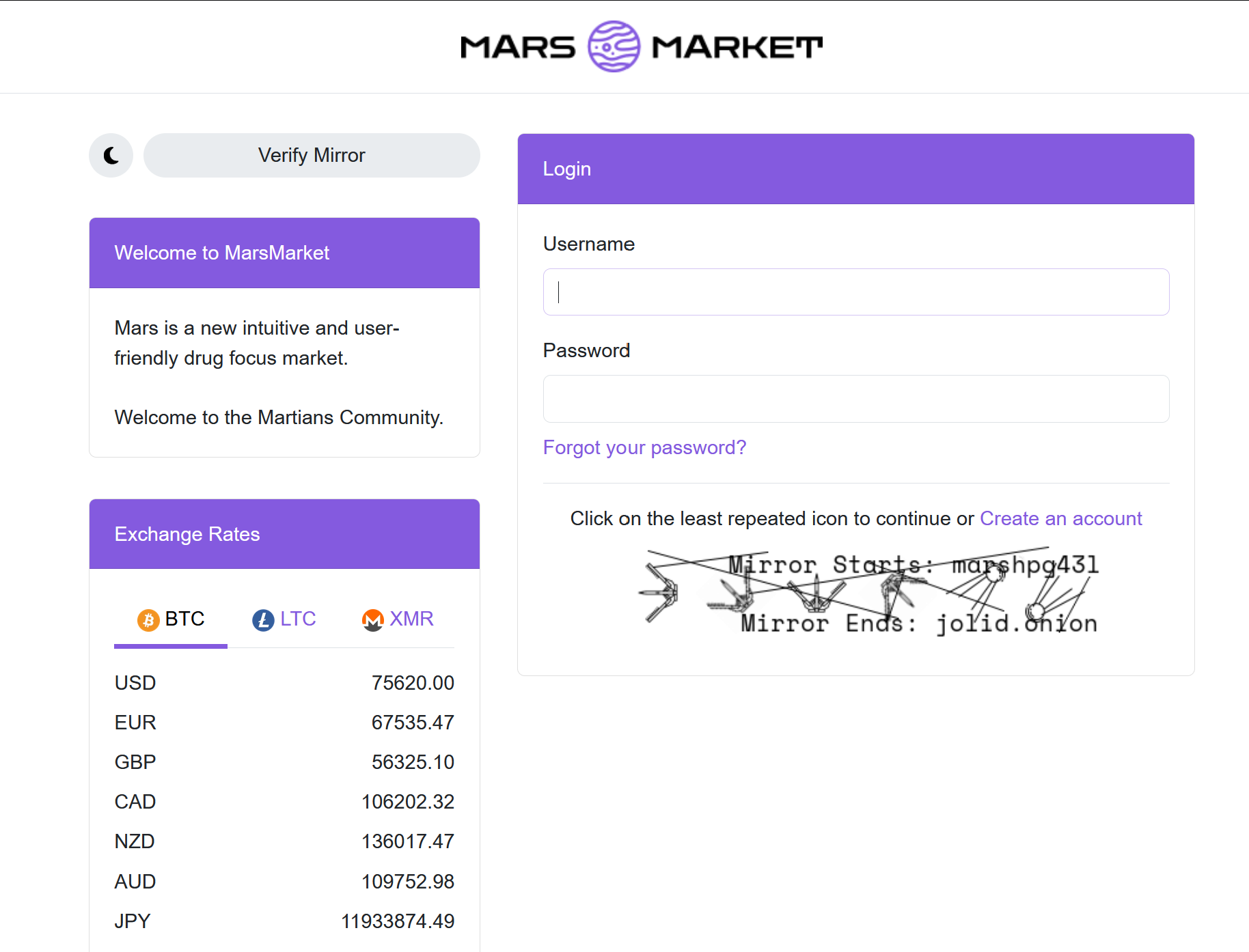
Is Mars Market legit, a scam, or a clone?
"Legit" covers three different questions, and Mars gets a different answer on each.
Is it a real market? Yes. Mars is a working marketplace: vendors with order histories, an escrow system that pays out, a support channel and a signed mirror list that has been maintained since January 2025. A scam front skips most of that, because its only goal is the first deposit.
Will it run off with the money? No market can promise it won't, and anyone who tells you otherwise is selling something. What Mars has is a record: twenty-two months without an exit or a seizure, in a stretch that saw Archetyp seized and Abacus, DarkMatter and Nexus exit. That counts for something, and it is not a guarantee.
Is the site in front of you actually Mars? This is where money really goes missing. Clone sites copy the Mars logo, the login page and even the start of the address, then collect passwords and swap the payment address on orders. Because Mars is walletless, a clone cannot drain a balance, so it goes after the order instead: you pay to its address and the vendor never sees a coin. Our guide to why Mars links differ between sites and how to check one covers the Mars side of this, and the general method is in how to verify an onion link against a signed message.
Twenty-two months old, mid-sized, still standing
Mars opened in January 2025, which makes it twenty-two months old this November: young next to Torzon, which has run since 2022, and old next to any market launched this year to catch the users other closures left behind. A 2023 launch date still floats around for Mars; it is wrong.
By listings, Mars sits in the middle of the field. Torzon is the largest market this autumn, and Mars is a different kind of place: drug-focused, with no deposit wallets. When DarkMatter, Nexus and Prime went down, their buyers and vendors had to go somewhere, and Mars was one of the established markets still standing to take them. Size cuts both ways. A bigger market has more vendors to compare and more coins in escrow at the moment of an exit; a mid-sized one has less of both, and draws less attention from police and from attackers.
Age is weaker evidence than it looks. An exit pays its operators whatever sits in escrow on the day, so the pull to exit grows with the market rather than fading with time, and the markets that died in 2026 were not new ones. Twenty-two months shows that Mars's operators have passed up every chance to exit so far, which is an argument that they are playing a long game and not proof of it. How DarkMatter, Nexus and Prime ended is on our page about darknet market exit scams and the signs that came before them, and the live field is compared in our darknet market list for this month.
Paying on Mars: escrow, direct pay and finalize early
Mars accepts Bitcoin and Monero. There is no account wallet: each order gets its own payment address, and you pay the exact amount to it. A Bitcoin payment is converted to Monero at checkout, which hides what happens after the coins reach Mars but does nothing for the Bitcoin trail that led there. What each coin reveals, and to whom, is in our explainer on Monero vs Bitcoin privacy; the Monero project's own FAQ is the place to check how Monero hides amounts and addresses.
What happens after you pay depends on how the vendor sells.
| Situation | Escrow order | Direct pay or finalize early |
|---|---|---|
| When the vendor gets the coins | When you finalize, or when the order's timer runs out | As soon as the payment confirms |
| Vendor never delivers | You open a dispute and staff rule on it | The money is gone; staff have nothing to hold back |
| Mars exits mid-order | Coins in open escrow are lost | Mars never held them, so its exit doesn't touch them |
| Vendor exits | Open orders can still be refunded by staff | Every order paid to that vendor is lost |
| Who it protects | The buyer, against the vendor | The vendor, against disputes |
Finalize early means releasing escrow before the order arrives, and direct pay means the vendor's listing skips escrow altogether. The two end in the same place: the dispute button no longer does anything. Direct pay is normally something long-standing vendors earn, and a vendor with a short history who asks you to finalize early is showing the most common warning sign of a vendor about to vanish.
One thing escrow does not cover is the market itself. While an order sits in escrow, the coins are at an address Mars controls. A walletless market keeps that pot smaller than a wallet market does, since nobody parks a balance there between orders, but the pot still exists.
How Mars login and 2FA work
A Mars account can be locked behind PGP: at login, after the password, Mars shows a block of text encrypted to the public key on your profile. You decrypt it with your private key and paste the code back. Vendor accounts have to use it. On a buyer account it is a setting, and turning it on is the first thing we do on any new account. Mars also offers TOTP, the six-digit codes from an authenticator app, as an optional extra layer.
What PGP login buys you: a password stolen from a reused login elsewhere, or read off a note, is not enough to get in. What it does not buy you is protection from a phishing page that relays everything to the real Mars and back. The challenge proves Mars can encrypt to your key; it says nothing about the address in your browser bar, which is why the address check on our Mars Market link page comes before any login. Setting up a key and passing the challenge is covered step by step in our guide on how to use PGP.
Where Mars posts its official announcements
Mars announces changes in two places: inside the market, and on Dread, the forum where most markets keep an official presence. A new mirror, a planned outage, a change to the rules: a genuine notice comes signed with Mars's PGP key, so treat an unsigned Mars post about addresses as written by a stranger.
Dread itself changed address on 7 October 2026, after both of its old addresses were taken over. Old Dread bookmarks now lead to hostile copies, which matters here because a fake Dread post is an easy way to plant a fake Mars address. The move and the new address check are on our Dread link page.
Is Mars Market safe to use?
Safe from what? Mars's design handles some risks well and cannot touch others, so the answer comes risk by risk.
- A lookalike site
- The most likely way to lose money. Mars's part is the signed mirror list; yours is checking every address against it before typing a password.
- The market exiting
- Limited by the walletless design to whatever is in escrow at the time. Keeping few orders open at once keeps your share of that small.
- A vendor exiting
- Covered by escrow, and only by escrow. Finalize early removes the cover.
- A seizure
- Not something any market's design prevents. When Archetyp was taken down in June 2025, police took the servers, and with them whatever the servers held. Messages left unencrypted on a market are readable by whoever ends up holding it.
- The payment trail
- Bitcoin is public from the moment it leaves an exchange; Mars's conversion to Monero starts after that. The payment explainer traces the whole path.
- Your own setup
- Tor hides your connection, not your habits. Reused usernames, a key with your real email on it and the same writing style in two places link people more often than any technical break. Our darknet OPSEC guide sizes these habits to the threat you actually face.
- The law
- Untouched by anything in Mars's design. Buying controlled drugs is a crime almost everywhere, and the 2025 police operations against dark web markets arrested buyers as well as vendors.
Mars is a poor fit for anyone who hasn't set up PGP yet, because the login challenge and every address check depend on it, and for anyone planning to trust a new vendor on direct pay.
What would warn that Mars is about to fail
The usual first sign of an exit, withdrawals that will not clear, cannot happen on Mars: there are no withdrawals. What we watch instead are the three places a walletless market shows strain:
- Vendors saying escrow releases are late. Payouts to vendors are the only money Mars sends out, so that is where trouble shows first, usually in vendor posts on Dread before anywhere else.
- A sudden switch to deposit wallets. Moving from per-order addresses to account balances creates a pot worth stealing. DarkMatter's last weeks were spent taking deposits it never paid out.
- The signed mirror list going stale. Mirrors dropping without a signed replacement, or announcements that stop carrying a signature.
Past those, Mars would fail the way any market does: checkout left open through a long "maintenance", staff going silent on Dread while support tickets pile up. Any one of these can be a bad week. Two at once is when we treat a market as on its way out. The order these signs usually come in, and the check we run on any market we hold coins on, are on the exit scam page.
Telling the real Mars from a copy
Mars is an onion service, so its address is derived from its own cryptographic key and cannot be faked character for character. A copy can only get close; the Tor Project's page on onion services explains why. That closeness is what clones rely on: they generate addresses that start with "mars" and count on you checking the first few characters and stopping.

The check that works is the whole address, all 56 characters before ".onion", against a mirror list signed by the Mars key you saved. Since October 2026 there is a second complication: more than one signed Mars list circulates, and more than one key is being passed around as Mars's. Which list is current and which key is real are settled on our Mars Market link page, and the key comes first: a mirror list signed by a fake Mars key verifies just as cleanly as the real one.